

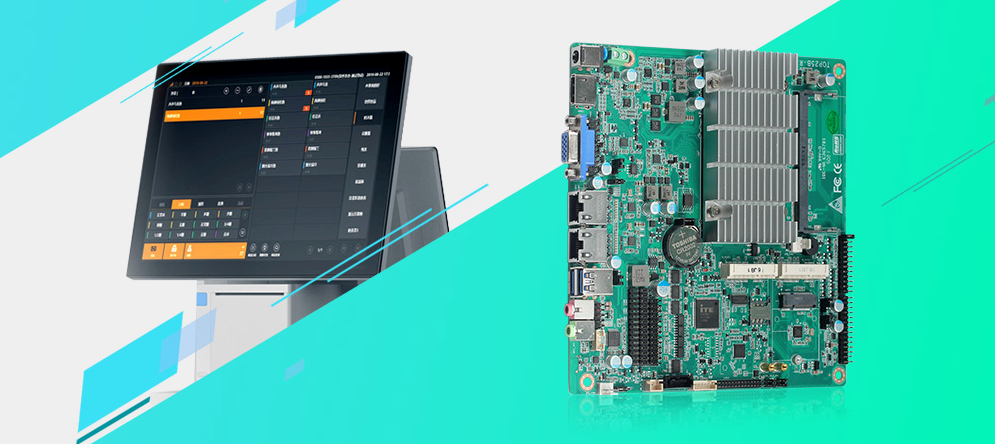
With the rapid development of mobile payment, mobile phones as a carrier of mobile payment make our transaction settlement faster. Considering commercial consumption settlement, the specific commercial application environment has also changed. POS cash registers have also been born. There are touchscreen pos machine, dual screen pos, electronic weighing, and even visual settlement. The types of POS machines are also rich and diverse. So today, let’s talk about what key factors we need to consider when selecting a cash register motherboard for a POS system? The details are as follows:
1. Processor performance:
The selected motherboard should have a powerful and efficient processor to ensure fast data processing speed and response time. This is essential for processing large amounts of transaction data and ensuring a smooth user experience.
At present, the mainstream POS on the market still uses the J1900 CPU, and many manufacturers have also launched an upgraded version of the J4125. And now i3、i5 or i7 motherboard is also widely used in the POS industry
2. Memory and storage:
Sufficient memory and storage space are the basis for ensuring the stable operation of the cash register. When choosing a motherboard, make sure it has enough RAM and storage capacity to cope with the growing data processing needs.
3. Expandability:
Consider future expansion needs and choose a motherboard with rich interfaces and expansion slots. This helps to accommodate future hardware upgrades, such as adding customer displays, pos printers, or scanners.
4. Durability and stability:
The operation of the POS system needs to be stable and reliable, so it is important to choose a durable and stable motherboard. Consider choosing a brand and model with a good reputation and reliable technical support.
5. Security:
Make sure the selected motherboard has appropriate security features, such as encryption technology, firewalls, etc. to protect the security of POS transaction data and customer information.
6. Compatibility:
Confirm that the motherboard is compatible with the required hardware and software, such as printers, scanners, and POS software systems.
7. Cost-effectiveness:
Choose a motherboard with a reasonable price to control procurement costs while meeting performance and functional requirements.
8. Ease of use:
Consider whether the motherboard is easy to install and maintain. Choosing a motherboard with good documentation support, easy-to-use interfaces, and intuitive management tools can reduce the complexity of use and maintenance.
9. Technical support:
Choose a brand that provides reliable technical support and after-sales service so that problems can be solved in time.
10. Environmental adaptability:
Consider the operating environment of the POS Hardware and choose a motherboard suitable for harsh environments. For example, for dusty or high-temperature environments, you may need to choose a motherboard with dust-proof and heat-dissipating functions.

In summary, when choosing a cash register system motherboard, you need to consider processor performance, memory and storage, scalability, durability and stability, security, compatibility, cost-effectiveness,
ease of use, technical support, and environmental adaptability. The right selection helps ensure the smooth operation of the POS systems, improve user experience, and reduce maintenance and upgrade costs.